
The Ethics of Australian Exports of Fossil Fuels to Japan
Climate crisis an urgent moral issue
It is ethically inconsistent to be committed to reducing domestic emissions and yet be willing to allow companies to export and trade in coal and gas. The burning of coal and gas in any country will contribute to the very same climate change that Japan and Australia are attempting to mitigate domestically. There is only one atmosphere the world shares.
Climate-related disasters are paid for in the loss of lives, homelands and livelihoods of hundreds of millions of everyday people while the profits are made by the relatively few, who unfortunately have significant influence over public debate and government decision making.
The Australian government’s highest duty is to keep Australians safe. Australia is predicted to be one of the countries that is most vulnerable to mega-fires, heatwaves, droughts and floods. Our generation has a duty of care particularly to the children and young people of today who will have to deal with the chaotic world which we are collectively creating for them.
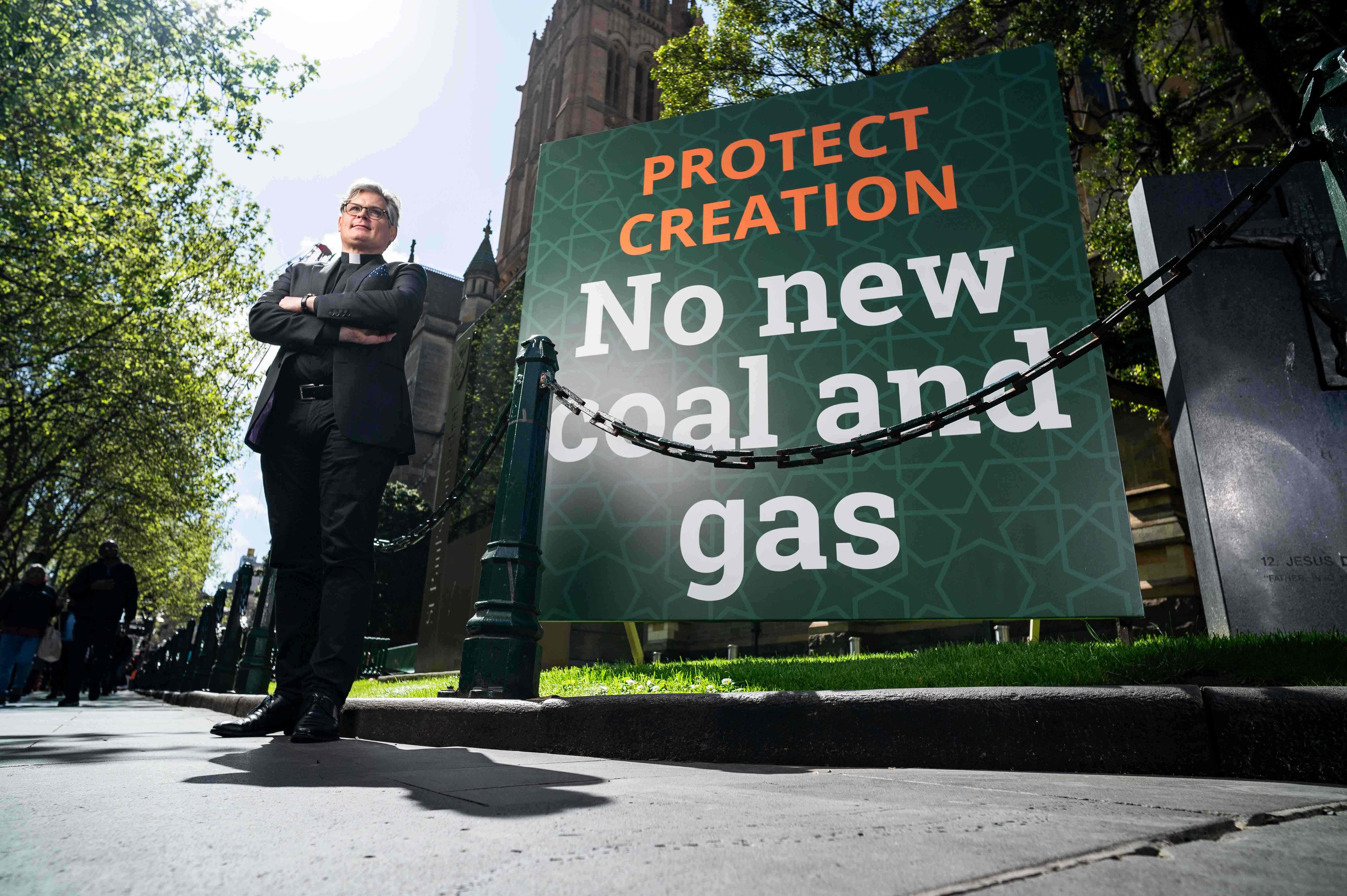
Dean Andreas Loewe of St Paul's Cathedral, Melbourne
Concerns regarding Japan
Japan has long had concerns about energy security because it is so reliant on imports of coal, oil and gas. The anxiety around energy security has been made worse by the Fukushima disaster which led to the large-scale shut-down of Japan’s nuclear industry.
While the country has signed the Paris Accord and made advances in energy efficiency and development of renewable energy generation, it has remained heavily reliant on fossil fuels. According to the International Energy Agency (IEA) in 2023, coal, gas and oil still supply the majority of Japan's energy needs, with around 70% of electricity generation relying on these sources, which are largely imported.
Japan imports much of its coal and gas from Australia, building on a long-standing relationship when it comes to energy trade. This reliance on the supply of fossil fuels from Australia must stop. Japan must throw away the crutch of fossil fuels and quickly transition to solar, wind, other renewables and battery storage.
The key advocates for the sale of Australian fossil fuels to Japan are profit-seeking Japanese corporations who heavily lobby the Japanese Government and put pressure on the Australian Government to allow this trade to continue.
In March 2023 the Japanese Government initiated the Asian Zero Emissions Community. The name of the initiative infers a commitment to decarbonisation but it is mostly about building gas infrastructure in Asian countries and on-selling LNG to those countries. Australia is part of AZEC.
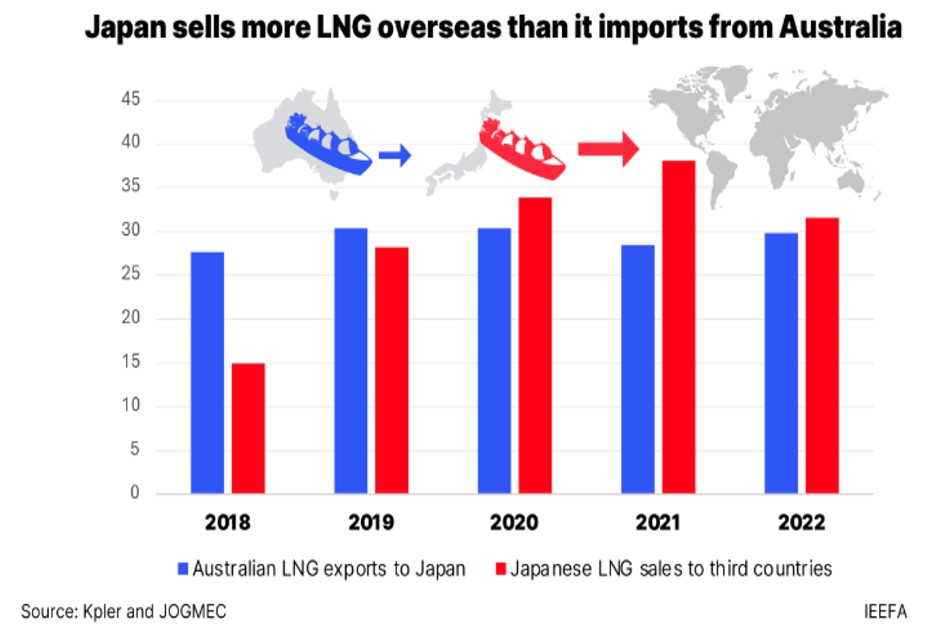
There’s a loophole in the G7 commitment to end public finance for fossil fuels that says such finance is acceptable if it’s needed for energy security. The Japanese Government therefore justifies its pro-LNG activities as needed for “energy security” but this is not true. From 2020 onwards, Japan has been on-selling more LNG to Asia than it imports from Australia.
LNG sales are projected to increase in the next few years. Japan’s LNG demand has fallen 25% since 2014 and is expected to drop another 25% by 2030. [1]
The views of Japan and Japanese companies are treated with great seriousness by the Australian Government, which in turn leads to Australia doing its best to please its trading partner.
Japan can maintain her energy security with greater investment in renewable energy, storage and other green technologies. Relying on LNG is delaying decarbonisation which will contribute to destabilising the climate and add to the risk of irreversible, runaway climate catastrophe.
Concerns regarding Australia
Regrettably, the Australian Government continues to approve new gas and coal projects, in contradiction to our Paris Accord commitment. Part of the reason behind these approvals is the Australian Government’s strong interest in remaining a stable trading partner with Japan.
Arguments for continuing to supply Japan with fossil fuels must be rejected because:
- The gas industry has paid very little in royalties or tax on exported gas, so it is unclear how ongoing gas exports are essential to the Australian economy. [2]
- Gas has a carbon footprint that is equivalent, or worse than coal. It follows that expanding the trade in LNG will not help decarbonise Japan’s economy.
- Japan has the potential to make 90% of its electricity generation clean by 2035 [3] and has been on-selling Australia LNG due to surpluses to their supply. [4]
- Continuing on this path is contrary to both the Japanese and Australian governments’ climate commitments. It is inconsistent with Australia’s ambition to co-host COP31 and to become “a clean energy superpower”. [5]
- Every dollar invested in fossil fuels is a dollar not spent on renewables, and the only beneficiary from ongoing gas reliance is the gas industry.
- The extraction process is destructive of Aboriginal spiritual connections to Country, local water resources and to the forests and reefs – and biodiversity.
In addition, research by The Australia Institute [6] shows that:
- The North West Shelf project has caused WA gas prices to triple since it was granted access to domestic gas in 2020.
- The extension will see around $215 billion worth of gas given away royalty-free.
- No gas exporter has ever paid petroleum resource rent tax and most pay zero royalties.
- Gas exporters have made $100 billion in windfall profits exporting Australian gas since Russia’s invasion of Ukraine.
The Australian Government claims that we need to continue developing gas fields or there will be shortages in the domestic market and higher prices. This is not true. LNG is relatively unaffordable in Australia, not because of insufficient reserves, but because LNG producers prioritise exports to take advantage of lucrative international spot markets rather than diverting those supplies to the domestic market. Consideration should be given to policy solutions, such as a gas reservation policy and measures to reduce domestic gas use. [7]
Gas has already lost much of its social license in the Australian community and this decline will continue further as people become more educated about issues around gas.
Conclusion
Both the Japanese and Australian Governments are encouraging the continued extraction, processing and trade in gas over the integrity of the earth’s climate, the safety of current and future generations and justice towards Australia’s First Nations peoples. They are heavily influenced by large corporations, mainly based in Japan, whose business models and pursuit of profit eclipse ethical considerations. A number of projects in northern Australia would not proceed except for Japanese investment.
This results in the Australian Government denying the needs and objections of many of its citizens, including Aboriginal and Torres Strait Islander Australians, in favour of expanding the extraction of gas and its export to Japan.
Strong calls from civil society are needed to challenge both governments to act more ethically.
The same kinds of issues seen in the trade in LNG between Japan and Australia play out globally. International society has been too slow to transition away from the mining, export and burning of fossil fuels and to accelerate investments in renewable energy, battery technology and energy efficiency. These unnecessary delays must stop.
ARRCC believes that environmental NGOs and activists everywhere must join together to stop the ongoing infliction of severe harm on the global environment. This can begin in Australia, in association with our fellow travellers on this Earth in Japan and in the Island Nations of the Pacific.
Prepared by Ms Thea Ormerod, ARRCC President
M: +61 405 293 466
Footnotes
[1] The Institute for Energy Economics and Financial Analysis (IEEFA
[2] Australia’s great gas giveaway - The Australia Institute
[3] Asian groups call on Australia to stop new fossil gas projects - The Australia Institute
[5] Joint media release: Australia’s International Climate Engagement | Ministers
Further references (Japan)
See this article by Dr Wes Morgan, expert in the Pacific and climate action at UNSW: https://www.climatecouncil.org.au/japans-net-zero-vision-region-boosts-gas-threatens-green-exports/
This article from the Centre for Strategic & International Studies gives a factual description of Japan’s management of the need for energy security.
Video of Japanese expert Yuki Tanabe (from Japan Center for a Sustainable Environment and Society), where the key message is that Japan is buying vast amounts of Australian gas and re-exporting in across SE Asian region:
Beyond the Energy Security Myth: Japan-Aus LNG | Yuki Tanabe
Further references (Australia)
[1] Australia’s great gas giveaway - The Australia Institute
[2] Asian groups call on Australia to stop new fossil gas projects - The Australia Institute
[3] Japan’s declining gas demand will leave utilities with persistent LNG oversupply through 2030 | IEEFA
[4] Joint media release: Australia’s International Climate Engagement | Ministers
[5] https://australiainstitute.org.au/post/big-gas-taking-the-piss-new-research-on-japanese-gas-giant-inpex/
[6] https://ieefa.org/resources/australian-gas-users-pay-price-lng-exporters-prioritise-spot-market-windfalls


